

Godspell by John-Michael Tebelak
University of Mary Washington
Klein Theatre
MEANING
Super-objective of the Play (aka “The Ruling Idea”)
Godspell is a wild play that brings a cacophony of strangers into a community to learn about the importance of Jesus’ teachings through games, modern references, and inclusion.
Dive deeper: Explanation
The characters take not only themselves but the audience with them on a journey to unity under Jesus’ guidance. In the beginning, the ensemble appears as separate individuals scattered around theatre, absorbed into practices and teachings of philosophies. After hearing others preach a philosophy they do not necessarily agree with, they join one another to be heard (fight for the right to talk). Through parables, games, and music, Jesus transforms these strangers into a supportive community. Each parable becomes a moral lesson the characters learn. With true discipleship, it is not blind leading the blind but the active choice to love others. Once Jesus faces betrayal and death, the group must decide whether to fall back into the way things were before or uphold what they have created. They spend their last moments carrying out his body amongst the crowd of people and learn how they can still build a beautiful city with him not around. Overall, Godspell teaches you that cooperation and hope are capable of binding people together even in a broken world.
Relevance
Personal Connection
I connect to Godspell because it speaks to the feeling of being thrown into a group of strangers I may or may not have worked with before and let us come together with a sense of belonging. In my own life through theatre ensembles, new classes, and unfamiliar environments, I’ve experienced these awkward stages where everyone’s guarding themselves. Usually it’s because of the overwhelming sense of not knowing how to interact. That’s what I love about us human beings today. Human connection works so well that you can practically figure out a person’s whole life story based on how they walk and talk. It’s essentially the same feeling of meeting a stranger for the first time, having a week’s worth of interactions, and later feeling like you’ve known them your whole life.
I also feel connected to the tension between playfulness and seriousness in the show. Much like the characters in Godspell, I tend to use humor as a bridge to take my mind off the more serious aspects of life. I’ve also learned that genuine bonds form when people are willing to be vulnerable. Ultimately, Godspell feels personal because it reflects how I navigate my own relationships. I always take precautions at first, then gradually increase my trust with others. With the show, it throws us on a fast journey to connect with strangers so that we can tell the meaningful stories we feel are important.
Social Relevance: Why do this play?
Godspell touches on many topics through its teachings that I believe parts of the world are not ready to hear. That may explain why those who did walk out on the show found it revolting or trying to convert them. Instead of preaching, the show invites audiences to rediscover or learn these playful stories through genuine connection. With the usage of phones and media, I personally think that we all isolate ourselves. Ever since the Covid pandemic took place, we have lacked lots of human interaction. So being able to go to a show that’s all about community reads as a blessing. There are billions of people in the world who speak different languages, have backgrounds, and beliefs that clash with others.
For many of our crowds being students, young adults, and older adults from an evolving generation, the show’s message resonates deeply. It speaks to people who are overloaded, isolated, or unsure how to form meaningful relationships in this broken world. Godspell gives them a theatrical space to witness strangers becoming family and challenges them to consider how they might nurture similar bonds in their own lives. Performing this play now highlights the importance of empathy at a moment when these values can feel scarce. It reminds audiences that joy and shared purpose are not forced ideals but powerful enough to reshape communities.
I’ve actually had the pleasure of speaking with a lot of people after the show who were brought to tears over this production. Lots of the responses were about how deeply the show connected them into the roots of their emotions and family dynamics.
INTERPRETATION
Problem (One Sentence)
The central problem is whether a disconnected group of individuals can learn to form and sustain a community in a world that’s resistant to unity.
Throughline of Action/Climax
The action follows Jesus as he gathers strangers and teaches them how to live with love. That love inspires them to become a unified community capable of continuing his message even after his passing. This goes hand-and-hand with the climax which occurs with Jesus’s Crucifixion.
Dive Deeper: Explanation
Characters like John/Judas support the action by serving as Jesus’ closest ally, but complicates it through doubt and betrayal. The climax, Jesus’ Crucifixion,puts the entire company under a big decision that could make or break their group. Without Jesus’s physical presence, the community could dissolve back into chaos. Instead, the company makes the choice to lift him and carry him forward, symbolizing the victory of the play’s main action. By the end, the ensemble’s community stands strong enough to survive loss. Each parable is a separate chapter, but together the group forms their journey on a more spiritual level.
Tone Goal
The audience’s emotional journey through Godspell should move from playful curiosity to communal joy. At the start, the audience should feel just as chaotic and confused as the actors during the Prologue. They then should be delighted and amused by the cast’s improvisation skills because it’s all lighthearted storytelling. Many of the cast members are jumping out of their characters to become masters, sheep, sons, trust servants, and kings. “I tell you, everything they do is done for show” as Jesus would say to allow the visual representations to connect in case you don’t necessarily understand the stories. As the characters pursue Jesus’ teachings, the audience should feel increasingly invested. There is so much sincerity underneath the acts of silliness. Moments of compassion should shift the tone from chaos to warmth. The only time the story really darkens is when Judas betrays Jesus; that’s the moment where the audience should feel the weight of loss and the fear that the community may collapse.
IMAGES
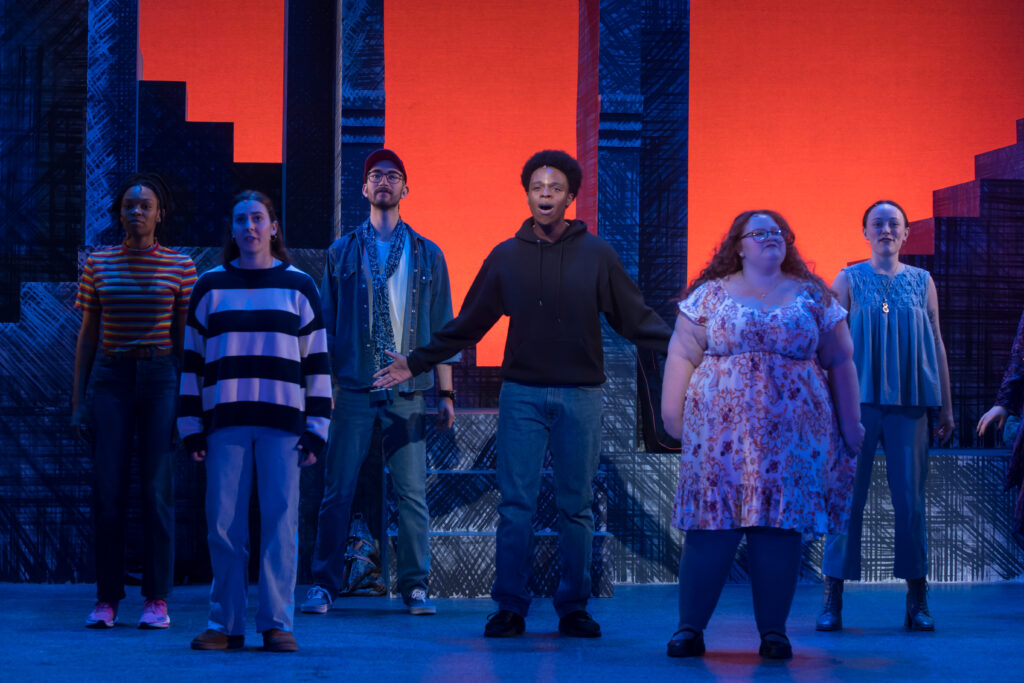
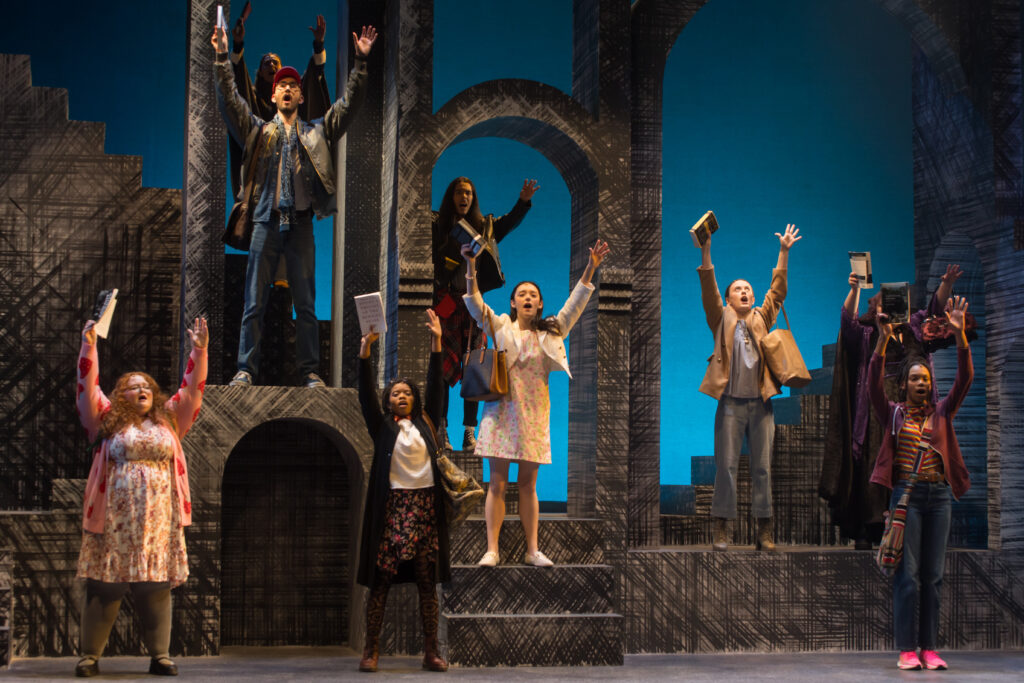

World of the Play (One Sentence)
The play is set on a stage with many arches and stairways that gradually turn into a playing space for the ensemble—foreshadowing the world of Godspell being a “clown show”.
Visual Metaphor (One Sentence)
The set’s painted hash markings, archways, and infinity-style staircases serve as a visual metaphor for a community sketching itself into existence—an unfinished world that the characters actively build together through Jesus’ teachings.